



Why now is the right time to build a career in industrial electronics repair
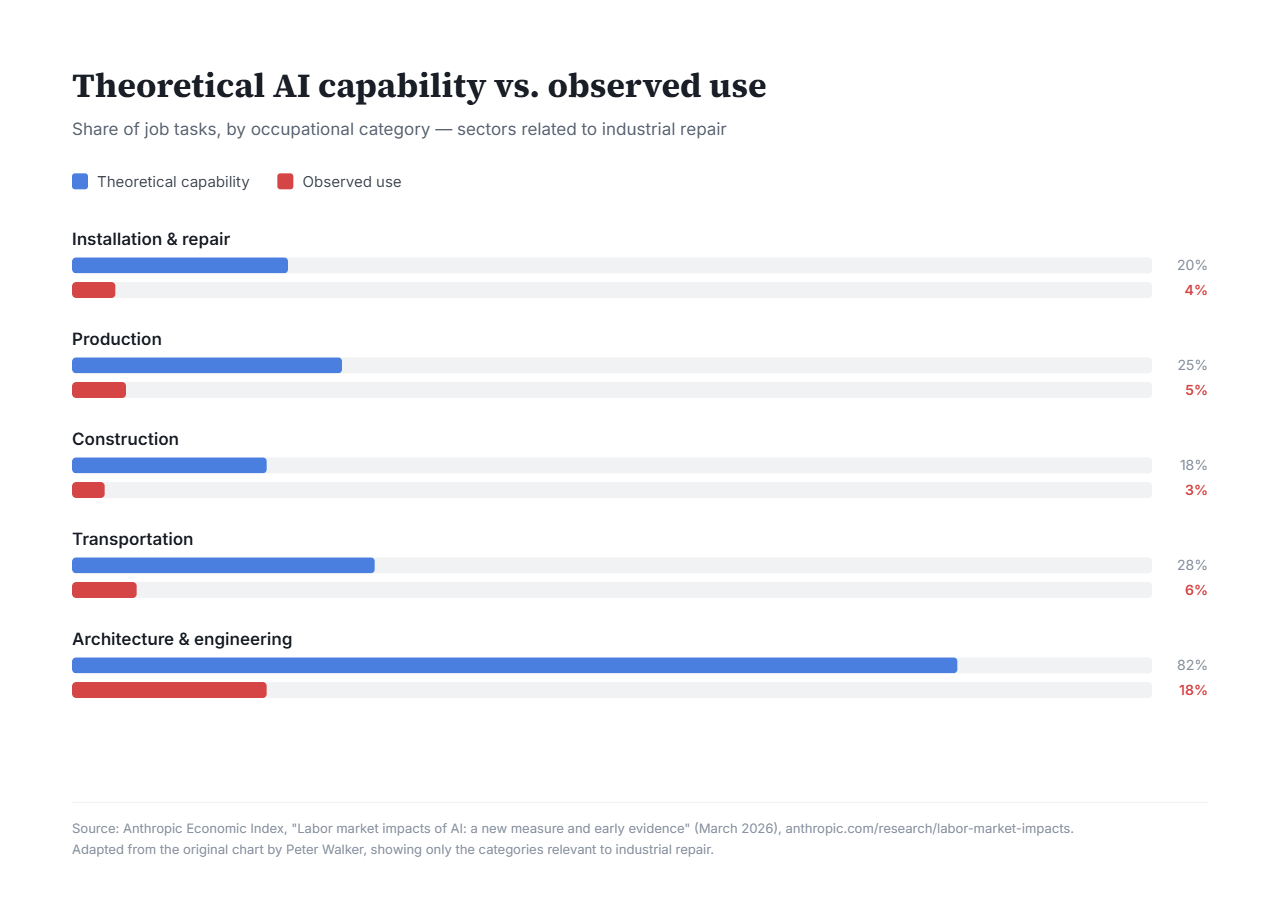
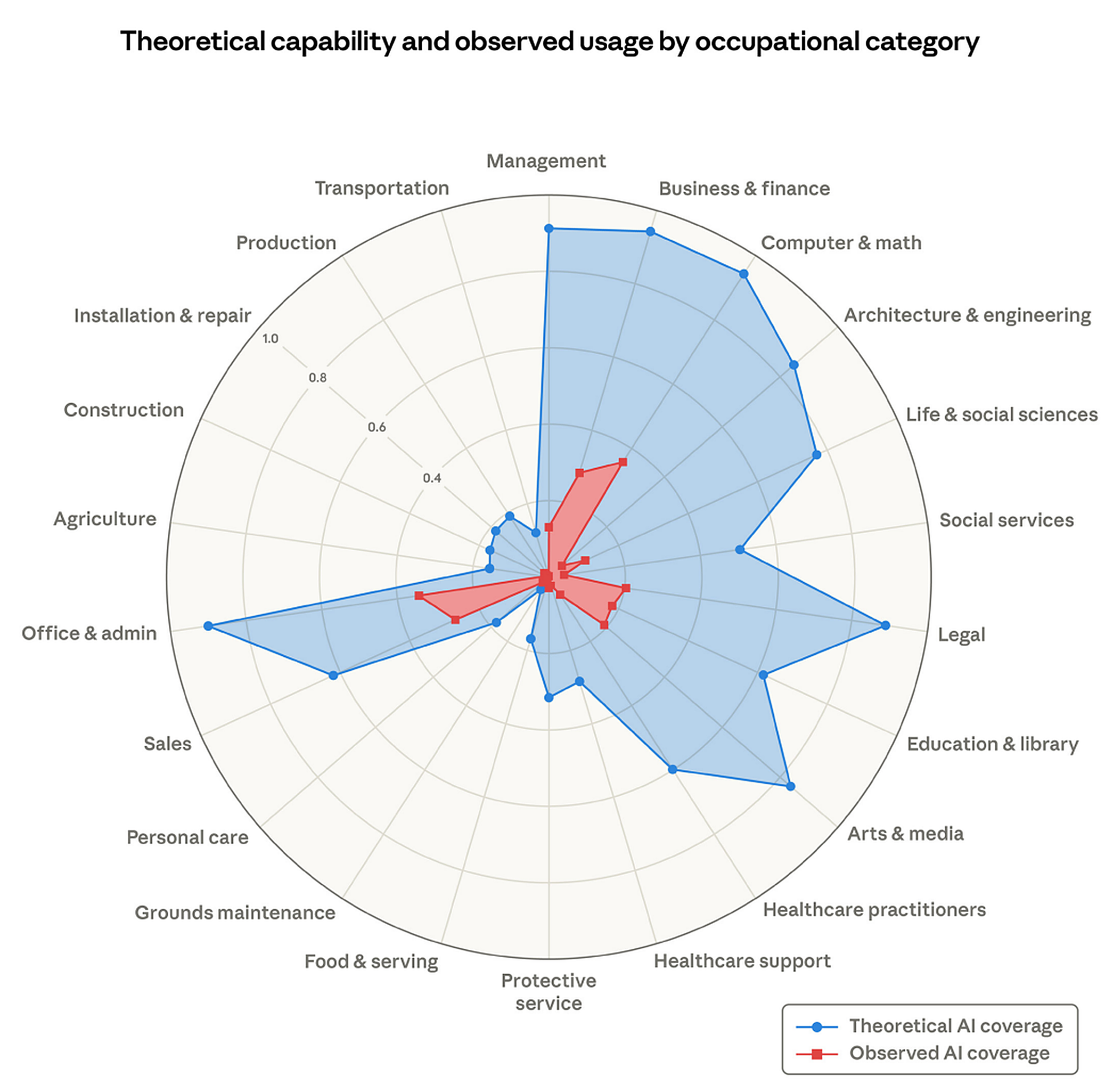
Anthropic’s March 2026 labour-market research places installation and repair among occupations with the lowest observed exposure to language models. In the accompanying visual, about 20% of tasks are theoretically capable of AI assistance, but only 4% appear in Anthropic’s observed-use measure. This research highlighted a career reality: work combining physical access, measurement, safety responsibility, and technical judgement is difficult to automate end-to-end.
Industrial electronics repair is more than replacing failed parts. It involves powered/unpowered testing, schematic interpretation, component-level fault isolation, reconstructing missing data, repair validation, and repeatable documentation.
AI can help
- Search manuals
- Analyse service history
- Suggest improvements
- Organise procedures
AI cannot
- Troubleshoot a circuit board
- Replace components on a PCB
- Calibrate a device
- Authorise safety-critical equipment for service return
Organisations increasingly need in-house expertise to reduce downtime, manage lifecycle costs, preserve technical knowledge and minimise electronic waste. This requirement is compounded by a new reality: critical assets remain in service for longer, OEM support is declining and components are becoming obsolete. As a result, demand for skilled electronics technicians and engineers will continue to grow over the next decade as industries rebuild the technical know-how lost over the past 20 years.
Across ABI’s work in defence, aerospace, rail, energy, semiconductor manufacturing and biomedical equipment, the pattern is consistent: Repair is moving from a workshop activity to a strategic asset-management capability.
Where will the strongest opportunities be?
Advanced manufacturing and semiconductor production.
- Automation does not remove maintenance work; it increases the number and complexity of assets that must remain available. The US Bureau of Labor Statistics projects 14% growth for industrial machinery mechanics, maintenance workers and millwrights from 2025 to 2035, with about 51,900 openings each year. Professionals who combine PCB fault-finding with PLCs, drives, robotics, sensors and condition monitoring will be valuable.
Energy and utilities.
Grid expansion, renewable generation, energy storage, and electrification depend on power electronics and control systems. The UK’s Clean Energy Jobs Plan models sector-supported jobs rising from 437,000 in 2023 to 856,000 by 2030. Skilled electrical and electronic trades are among the largest growth groups. US projections also show 10% growth for powerhouse, substation, and relay electronics repairers.
Aerospace, defence and rail.
- These sectors operate regulated, high-value assets over long service lives, often beyond original OEM support. Avionics and aircraft maintenance employment is projected to grow 6%, with 13,100 openings annually. In UK rail, up to 70,000 workers could leave through attrition by 2030, while gaps remain in signalling, telecoms, systems engineering and electrification. Sovereign repair, obsolescence management and technical-data recovery will become increasingly important.
Healthcare technology.
- Medical equipment repair employment is projected to grow 13%, driven by expanding demand for diagnostic, monitoring and treatment equipment. This field rewards technicians who can combine electronics, calibration, software, traceability and regulatory discipline.
For apprentices, career changers and service leavers entering the profession, the strongest foundation is practical:
- Circuit theory, analogue/digital electronics, schematic reading, measurement discipline, soldering/rework, ESD control, safe powered testing, root-cause analysis and technical reporting. Add recognised quality training, sector safety credentials, plus reliability and obsolescence knowledge. Learn to use AI as an engineering assistant, not as a substitute for evidence.
The most valuable repair professionals will not only fix one board. They will turn that repair into a controlled test procedure, preserve the knowledge and help an organisation prevent the next failure. That creates a career path from technician to diagnostics engineer, reliability specialist, obsolescence manager and MRO capability leader.
For practical problem-solvers, this is a sound career move. Assets are becoming more complex, downtime is more expensive, and people who can diagnose, recover and sustain them gain value. That is the capability at the heart of Repair, Don’t Waste.

This article is published on Repair Day 2026, the tenth edition, whose theme is how repair brings us together. The data above shows why that theme matters for careers too: repair keeps the handoffs between people in the loop. The technician, the engineer and the person who signs off on return-to-service all stay involved, which automation in many other fields does not.
Footnote: The employment figures were checked against current US Bureau of Labor Statistics projections. UK energy and engineering priorities are supported by the Clean Energy Jobs Plan and Skills England’s assessment, while the rail figure comes from NSAR’s 2025 workforce survey.